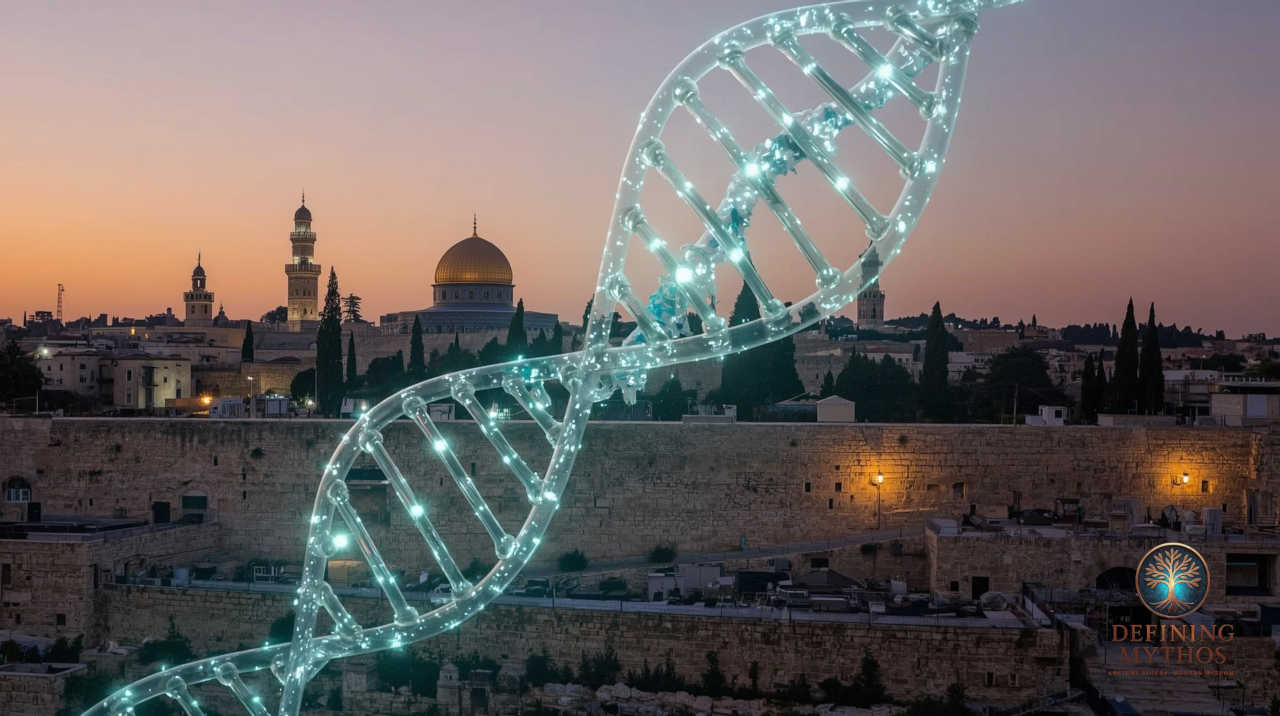
In a land defined by division, modern science has uncovered a secret hidden in the blood and bones of the people who call it home. It’s a truth that complicates narratives, challenges identities, and tells a story of kinship where we expect to find difference. From a purely genetic standpoint, many Jews and Palestinians are cousins, branches of the same ancient family tree.
Sometimes, the simplest discoveries hold promise of new insight and new beginnings. But genetic findings are most constructive when they are used to build a framework for peace, not as a replacement for political negotiation. Genetics, or shared ancestry cannot solve a political conflict on their own.
Modern genetic studies have revealed something striking: both Jews and Palestinians (alongside Lebanese, Druze, and Syrians) share a deep ancestral connection to the Bronze Age peoples of the Levant, often referred to as the Canaanites. Ancient DNA recovered from Canaanite remains in Israel and Lebanon (c. 3,000 years old) shows a clear genetic link to present-day Levantine populations.
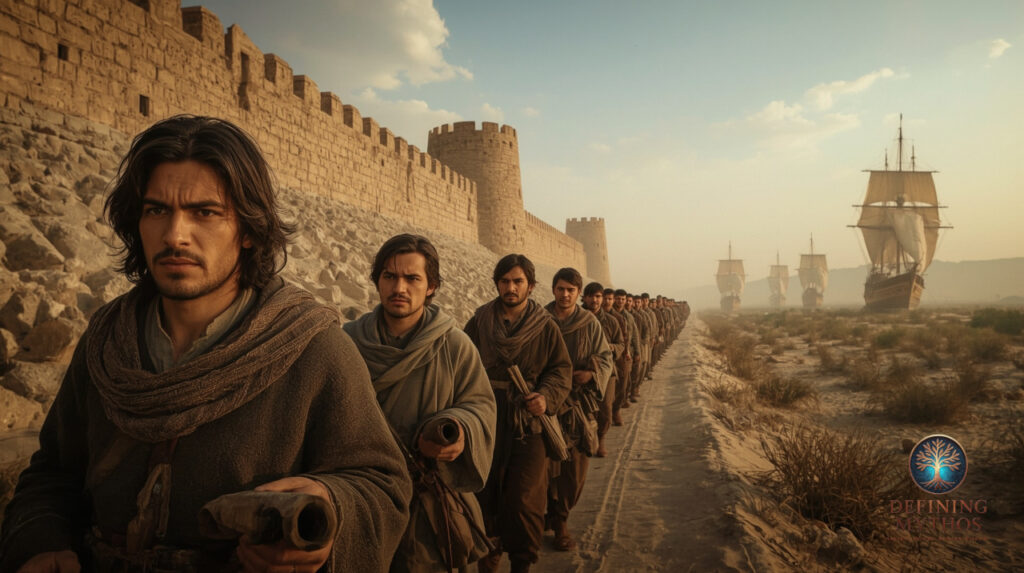
A landmark study (American Journal of Human Genetics, 2017) concluded that “present-day Lebanese derive most of their ancestry from a Canaanite-related population.” Other research (PNAS, Nebel et al. 2000; Cell, Haber et al. 2017) has found that Jews and Palestinians both carry these same ancient lineages.
What divides them now is not ancestry, but politics, territory, and differing historical narratives.
This irony — of people locked in modern conflict while sharing deep common roots — is one of the most striking lessons from modern genetics – and archeology. It underlines how history, memory, and identity often overshadow biology, even when the science shows kinship instead of difference.
One Root, Two Branches
If the genetic roots are the same, why are the identities so different today? History took these two groups on profoundly different journeys.
- The ancestors of the Jewish people were the ancient Israelites and Judeans who emerged from this Levantine population, creating a distinct national and religious identity. During the Diaspora, most were scattered across the globe, carrying their Levantine ancestry with them. While they mixed with host populations in Europe, North Africa, and the Middle East, this core genetic link to their ancient homeland was remarkably preserved.
- The ancestors of the Palestinian people, for the most part, never left. They were the Judeans, Samaritans, and Galileans who remained in the land. Over centuries, many converted to Christianity during the Roman and Byzantine eras, and later, the majority converted to Islam after the Arab conquest in the 7th century. The language and religion shifted, but the people and their genetic foundation remained fundamentally Levantine.
In essence, one branch of the family went into exile and largely maintained its identity, while the other branch stayed home and adopted new religions and cultures over time.
The Stones Don’t Lie
The archaeology of the Levant tells the same story as the genetic research, just from a different angle. While genetics tracks the biological lineage of the people, archaeology tracks their cultural continuity.
The archaeological record shows no evidence of a massive, wholesale population replacement that would contradict the genetic findings. Instead, it reveals a deeply rooted population that has continuously adapted, evolved, and changed its cultural and religious identity over thousands of years.
One Land, Many Layers
Think of an archaeological site in the region, like Jerusalem or Jericho, as a layer cake of history. As you dig down, you find distinct layers: Islamic, Byzantine, Roman, Hellenistic, Persian, Iron Age (Israelite), and Bronze Age (Canaanite).
Crucially, while the “flavor” of each layer is different—reflecting new empires, religions, and languages—the fundamental “ingredients” of the material culture often show a gradual evolution rather than an abrupt break. Pottery styles, building techniques, and agricultural practices frequently evolve from the layer below. This suggests that in many cases, it was the same core population adapting to new rulers and new ideas, not a completely new group of people arriving and starting from scratch.
Debunking “Conquest and Replacement” Narratives
Archaeology challenges the idea that major historical shifts were caused by one population completely wiping out another.
- The Emergence of Israel: The biblical story in Joshua describes a swift and total military conquest of Canaan. Archaeology, however, suggests a much more gradual process. Many scholars now believe the early Israelites were themselves a subset of Canaanite peoples who developed a distinct identity and religion over time. There is no archaeological evidence for a massive, unified invasion from the outside that replaced the Canaanite population. This aligns perfectly with the genetic data showing that Israelites grew out of the Canaanite gene pool.
- The Arab Conquest (7th Century CE): The arrival of Islam was a monumental religious and political shift, and it brought the Arabic language.3 However, it was not a demographic replacement. The conquest was led by a relatively small Arab elite and army. The vast majority of the existing population—Aramaic and Greek-speaking Christians, Jews, and Samaritans—were not driven out or annihilated. Instead, over several centuries, most of them gradually converted to Islam and adopted the Arabic language.
In both of these pivotal moments, the archaeology shows a cultural and religious transformation, not a population replacement.
The Verdict from the Stones
Both the stones and the genes tell a consistent story. They reveal a land inhabited by a deeply rooted Levantine people who have been remarkably resilient. While empires have risen and fallen, and religions have come and gone, the descendants of the ancient inhabitants have remained, adapting and evolving into the distinct but closely related peoples we know today as Jews and Palestinians.
A Conflict of Kin
This scientific revelation presents a stunning irony. The conflict that dominates the headlines is not between two alien peoples, but between two closely related populations fighting over the same ancestral land.What divides them is not biology, but the powerful forces of history, memory, politics, and two competing national stories. Genetics cannot solve the conflict, but it offers a profound and humbling perspective. It reminds us that identities are complex layers built on top of a shared foundation, and that beneath the narratives of division, there is a story of deep, undeniable kinship.
📚
Sources & Additional Reading
📌 Landmark 2017 Study
Marc Haber, Claude Doumet-Serhal, Christiana Scheib, et al.
Continuity and Admixture in the Last Five Millennia of Levantine History from Ancient Canaanite and Present-Day Lebanese Genome Sequences.
American Journal of Human Genetics, Vol. 101, Issue 2, 2017, pp. 274–282.
DOI: 10.1016/j.ajhg.2017.06.013
- Sequenced DNA from five Bronze Age Canaanite skeletons (Sidon, ~3,700 years old).
- Compared with modern Lebanese genomes (≈93 samples).
- Found strong genetic continuity: modern Levantines (including Jews and Palestinians) share ancestry with Bronze Age Canaanites, alongside later admixtures.
📌 Supporting Studies
Nebel, A., Filon, D., et al. (2000).
The Y chromosome pool of Jews as part of the genetic landscape of the Middle East.
Proceedings of the National Academy of Sciences (PNAS), 97(12), 6769–6774.
DOI: 10.1073/pnas.100115997Showed Jewish and Palestinian populations share major Y-chromosome lineages, pointing to common Levantine roots.Haber, M., et al. (2017).
Continuity and Admixture in the Last Five Millennia of Levantine History.
Cell, 170(6), 1100–1115.
DOI: 10.1016/j.cell.2017.07.019Expanded dataset: genome-wide analysis of ancient Levantines.Confirms Canaanite ancestry in Jews, Palestinians, Lebanese, Syrians, Druze.
🏺 Archaeology and History
- Dever, William G. (2003). Who Were the Early Israelites and Where Did They Come From?→ Argues against the biblical “conquest model”; presents archaeological evidence that Israelites were indigenous Canaanites who evolved a distinct identity.
- Finkelstein, Israel & Silberman, Neil Asher (2001). The Bible Unearthed: Archaeology’s New Vision of Ancient Israel and the Origin of Its Sacred Texts.→ Lays out how archaeology undermines the conquest narrative and supports continuity between Canaanites and Israelites.
- Stager, Lawrence E. (1985). “The Archaeology of the Family in Ancient Israel.” Bulletin of the American Schools of Oriental Research.→ Shows cultural continuity between Bronze Age Canaanites and Iron Age Israelites in household religion.
- Kuhrt, Amélie (1995). The Ancient Near East, c. 3000–330 BCE.→ Comprehensive overview of political and cultural continuity across empires, useful for showing how populations adapted rather than replaced.
📖 Broader Context: Identity and Continuity
- Sand, Shlomo (2009). The Invention of the Jewish People.→ Controversial but thought-provoking book that critiques myths of total exile and “replacement,” suggesting continuity in the land.
- Shahid, Irfan (2002). Rome and the Arabs.→ Explains how Arab presence in the Levant predates Islam, contextualizing the 7th-century shift as cultural-political rather than demographic.
- Taylor, Joan E. (2012). Christians and the Holy Places: The Myth of Jewish-Christian Origins.→ Examines continuity and religious change in the Levant during Late Antiquity.
References for Further Reading
- Nebel et al., PNAS (2000) – Y-chromosome studies of Jews and Palestinians.
- Haber et al., Cell (2017) – Genetic continuity in the Levant since the Bronze Age.
Leave a Reply